Your Trip Story
The first sound that really lands is the call to prayer slipping over the rooftops of the medina just as the shopkeepers rattle open their metal grates. The air smells like orange blossom, exhaust, and yesterday’s cumin. Somewhere down a side alley, a hand drum thuds in rehearsal for the night ahead. Marrakech in December runs on contrast: cold blue mornings, honeyed afternoon light in Mouassine, and nights that belong to Gnawa rhythms and jazz basslines. This trip leans into that soundtrack. Instead of chasing every monument, you trace the city’s musical spine: from the Museum of Mouassine Music to smoky jazz terraces off Rue Riad Zitoun, from rooftop oud sets near Jemaa el-Fna to Gueliz bars where the wine list quietly slips in Moroccan naturals. You’re not here to tick boxes; you’re here to hear how the city actually sounds when the tour groups drift back to their riads. Across three slow days, the story arcs from orientation to improvisation. Day one keeps you mostly in the old town: medina lanes, Mouassine’s changing-face streets that locals say are the “bougie” edge of the souks, live sets threaded between tagines. Day two crosses the invisible border to Gueliz, where specialty coffee, galleries, and wine bars sit on wide French-era boulevards. By day three, you’re moving confidently between Koutoubia’s gardens, Ben Youssef’s carved quiet, and rooftop restaurants where the evening playlist slides from jazz to deep house without anyone making a fuss. You leave with more than photos of Jardin Majorelle blue and tiled courtyards. You leave with a map in your head of where the best handpan player sets up near Souk Semmarine, which rooftop bar pours the most interesting glass with your kefta, and how the medina feels at midnight when the last drumbeat fades and the air finally cools on your skin. The city doesn’t become less chaotic—but it starts to play in time with your own rhythm.
The Vibe
- Medina Grooves
- Natural Wine Curious
- Slow-Burn Evenings
Local Tips
- 01Cash is still king in the medina; keep small notes for souks and traditional spots, and save cards for newer Gueliz bars and restaurants.
- 02In the souks around Souk Semmarine, haggling is expected—start at about a third of the first price and keep it light and good-humored.
- 03Dress modestly (shoulders and knees covered) away from hotel pools and nightclubs; it’s basic respect and locals notice the effort.
The Research
Before you go to Marrakech
Neighborhoods
For an authentic experience in Marrakech, explore the Mouassine neighborhood, known for its upscale vibe and proximity to the Souk Semmarine. This area offers a blend of boutique shopping and traditional crafts, making it a perfect spot to immerse yourself in local culture while enjoying a more relaxed atmosphere.
Events
If you're visiting Marrakech in December 2025, don't miss the international film festival that showcases a week of films and events throughout the city. This vibrant festival is a cultural highlight and provides a unique opportunity to engage with both local and international cinema.
Food Scene
For budget-friendly dining, seek out local favorites like the hidden gem eateries recommended in the Marrakech Forum. These spots offer delicious, inexpensive Moroccan cuisine and often feature traditional dishes that you won't find in tourist-centric restaurants, making them a must-visit for any backpacker.
Where to Stay
Your Basecamp
Select your home base in Marrakech, Morocco — this anchors your journey and appears in the navigation above.
The Splurge
$$$$Where discerning travelers stay

La Mamounia
La Mamounia is all shadowy corridors, deep jewel-toned fabrics, and courtyards where the scent of orange blossoms hangs in still air. The lobby feels like a film set: dim lighting, polished marble underfoot, and staff moving with quiet efficiency.
Try: If you splurge, take tea or a cocktail in one of the bars and wander the garden paths afterward.
The Vibe
$$$Design-forward stays with character

Jnane Tamsna
Set in the Palmeraie, Jnane Tamsna is a cluster of earthy buildings wrapped in lush gardens, where gravel paths lead to quiet corners and five different pools glint between palms. The air smells like damp earth, herbs, and sun-warmed stone, and the only consistent sound is birdsong.
Try: Have a long lunch in their restaurant, then claim a shady sun lounger with a book.
The Steal
$$Smart stays, prime locations

BÔ Riad Boutique Hôtel & SPA
This riad balances value and style: clean lines, a small courtyard, and a compact spa where the smell of black soap and eucalyptus hangs in the air. The atmosphere is relaxed, with the low echo of footsteps on tile and occasional splashes from a plunge pool.
Try: Book a traditional hammam followed by a massage to reset your body from all the walking.
Day by Day
The Itinerary

Culture
Day 1: Mouassine Echoes & Medina Afterglow
The day begins in the cool hush of Mouassine, where the first shafts of light slide between wooden souk roofs and catch dust in the air like stage smoke. You slip through a narrow derb and into the Museum of Mouassine Music, where the creak of old wood and the soft jangle of instruments on display set the tone: this trip is about what Marrakech sounds like as much as what it looks like. By late morning, you’re walking past Koutoubia’s gardens, the stone underfoot still cold, the smell of damp earth and orange trees softening the city’s edges. Lunch happens above the chaos at Rooftop Restaurant El Kennaria, where the clatter of Jemaa el-Fna drifts up as background percussion to plates of grilled meat and mint tea. The afternoon is for decoding the medina with a local guide, weaving through Souk Semmarine’s changing face—traditional stalls on one side, more polished Mouassine boutiques on the other—learning which alleys hide real artisans and which are just for tour groups. As the light turns copper, you sit down at Tanjia secrets for slow-cooked tangia and bread still warm enough to tear with your fingers. Night falls properly at Le Bistro Arabe, on a terrace where the first jazz notes cut through the murmur of the old town and candles throw soft light on tile and brass. Later, the evening spills into the Marrakech Nightlife Adventure pub crawl, trading quiet riad courtyards for bars where the bass is low, the crowd loose but friendly, and the smoke in the air mixes with citrus peel from freshly cut garnishes. Tomorrow, the soundtrack shifts west to Gueliz—espresso machines, gallery chatter, and a different kind of night music.
Museum of Mouassine Music
Museum of Mouassine Music
An old medina house turned intimate music museum, its rooms are dim and cool, lined with glass cases of lutes, drums, and fiddles that catch stray beams of light. The creak of wooden floors and the faint crackle of archival recordings give the space a lived-in, almost private feel.
Museum of Mouassine Music
From Mouassine, follow the signs and flow of people south toward Koutoubia; it’s a 15–20 minute walk through the medina to the mosque gardens.

Koutoubia
Koutoubia
Koutoubia’s minaret rises from a plaza of trees and fountains, its sandstone surface shifting color with the light. The surrounding gardens are calm, with the scent of orange blossoms and damp soil softening the city noise from the surrounding roads.
Koutoubia
From the gardens, head northeast toward Jemaa el-Fna and continue along Rue Kennaria; follow signs up to the rooftop entrance of El Kennaria.

Rooftop Restaurant El Kennaria
Rooftop Restaurant El Kennaria
Up a narrow stairwell, El Kennaria’s rooftop opens to a simple terrace with wooden tables, woven chairs, and shade sails fluttering above. The sound of Jemaa el-Fna below is softened by distance into a steady, almost musical murmur.
Rooftop Restaurant El Kennaria
After lunch, meet your guide at a pre-arranged spot near Jemaa el-Fna for your medina shopping tour—usually a 5–10 minute stroll back down Rue Kennaria.
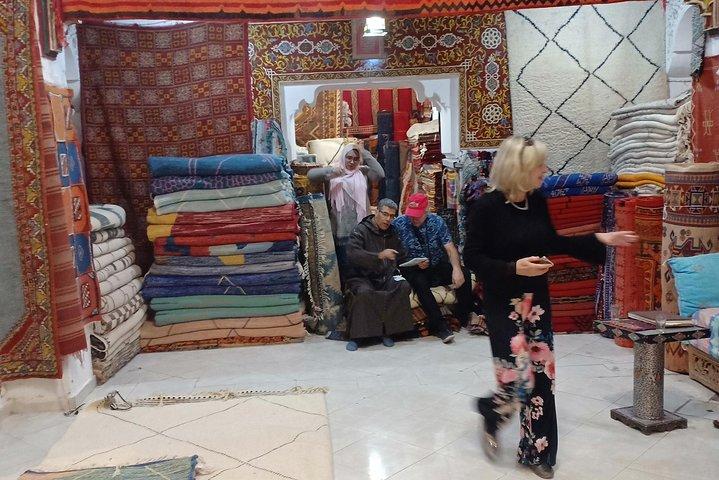
Marrakech Shopping Tour: Medina Secrets
Marrakech Shopping Tour: Medina Secrets
This guided walk feels more like being shown around by a plugged-in friend than a megaphone tour: side alleys, quiet courtyards, and workshops where tools and half-finished pieces lie on worn wooden benches. The soundtrack is artisans chatting over the tap-tap of hammers and the whirr of sewing machines.
Marrakech Shopping Tour: Medina Secrets
Your guide can walk you toward Riad Zitoun el Kdim at the end of the tour, from where it’s a short walk to Tanjia secrets in the old town.

Tanjia secrets
Tanjia secrets
Down a narrow medina lane, this small dining room glows with amber light bouncing off patterned walls and simple wooden tables. The air is heavy with the smell of slow-cooked meat, cumin, and preserved lemon, wrapping around you the moment you step in.
Tanjia secrets
From the restaurant, it’s about a 10–15 minute walk through the medina to Le Bistro Arabe near Riad Zitoun el Kdim—follow your map and the thinning crowds.

Le Bistro Arabe - Moroccan Jazz Restaurant in Marrakech
Le Bistro Arabe - Moroccan Jazz Restaurant in Marrakech
Tucked off a side street, this restaurant opens into a plush, low-lit space and terrace where candlelight hits glassware and tiled surfaces just right. Live jazz adds a warm, velvety layer of sound over the clink of cutlery and murmur of diners.
Le Bistro Arabe - Moroccan Jazz Restaurant in Marrakech
After the set, meet up with your group nearby for Marrakech Nightlife Adventure—the guide usually coordinates a central medina pickup.

Marrakech Nightlife Adventure: The Ultimate Pub Crawl
Marrakech Nightlife Adventure: The Ultimate Pub Crawl
This curated crawl jumps between bars and clubs where the lights get progressively lower and the playlists louder. You move as a small convoy along city streets, the smell of shisha and fried snacks meeting you at each new doorway.
Marrakech Nightlife Adventure: The Ultimate Pub Crawl

Food
Day 2: Gueliz Coffee, Natural Wine & Soft Neon
Morning in Gueliz feels like a different city: wide pavements, horn blasts on Avenue Hassan II, and the smell of espresso instead of charcoal grills. At Thirty5ive Marrakech, the hiss of the steam wand and a playlist of jazzy R&B replace yesterday’s call to prayer as your alarm. The light is bright and clean through big windows, catching on art prints and laptop screens, and the texture of the day is smoother—less stone underfoot, more concrete and café chairs. After a slow start, you slip into the calmer shade of Jardin Majorelle, where gravel paths, cacti, and that Yves Saint Laurent blue bounce cool light back into your eyes. Lunch at Le Bistrot d’Amaia introduces you to the Gueliz way of eating: draft beer, wine-friendly plates, and a clientele that looks like a mix of locals, expats, and off-duty creatives. The afternoon is for lingering: maybe a glass at Barbe, where the owner talks you through Moroccan bottles like they’re old friends, then a meandering walk past Rue Mohammed el Beqal’s bars sizing up where you’ll return after dark. Dinner at Cantine Mouton Noir leans into meat and texture—char, fat, crisp edges—before the night softens at BAROMETRE, a subterranean cocoon of amber light and meticulous cocktails. The soundtrack tonight is more synth and downtempo than drums; tomorrow you’ll swing back toward history and medina acoustics, but for now, the city feels like any good European night out—just with the occasional call to prayer threading through the bass.

Thirty5ive Marrakech
Thirty5ive Marrakech
A bright, modern café-gallery, Thirty5ive has big windows, pale walls hung with art, and the steady hiss of an espresso machine. The smell of specialty coffee and fresh pastries fills the space, while a jazzy R&B playlist keeps things gently upbeat.
Thirty5ive Marrakech
From Thirty5ive, grab a petit taxi or walk 20–25 minutes north toward Jardin Majorelle along main avenues.

Jardin Majorelle
Jardin Majorelle
Inside the walls, Jardin Majorelle is a carefully composed dream of cacti, bamboo, and that electric blue villa, with gravel paths that crunch underfoot. The air is cooler and smells faintly of damp soil and greenery, a relief from the dry city streets outside.
Jardin Majorelle
Exit the garden and catch a taxi back toward Avenue Hassan II; Le Bistrot d’Amaia is a short ride away along that main road.
Restaurant - Le Bistrot d'Amaia - Bar à Vins - Pub - Draft beer
Restaurant - Le Bistrot d'Amaia - Bar à Vins - Pub - Draft beer
On Avenue Hassan II, this spot feels like a cross between a French bistro and a locals’ pub: wooden tables, a long bar, and a faint haze of cigarette smoke curling under warm lights. The clink of draft beer glasses and low TV murmurs set an easy, lived-in tone.
Restaurant - Le Bistrot d'Amaia - Bar à Vins - Pub - Draft beer
From here, it’s a short stroll into the heart of Gueliz; walk 10–15 minutes to Barbe. Marrakech along Rue Yougoslavie.

Barbe. Marrakech
Barbe. Marrakech
A compact wine cave hidden off Rue Yougoslavie, Barbe is all shelves of bottles, a small tasting counter, and the low, warm lighting of a serious cellar. The air is cool and smells like cork, stone, and a faint hint of oak.
Barbe. Marrakech
Stay in Gueliz and walk 5–10 minutes up Rue Mohammed el Beqal toward Cantine Mouton Noir for dinner.

Cantine Mouton Noir
Cantine Mouton Noir
A compact, low-lit dining room with dark tones and an open view into the kitchen, Cantine Mouton Noir smells like seared meat, butter, and reduced sauces. The soundtrack is low and unobtrusive, letting the sizzle from the grill and quiet conversation dominate.
Cantine Mouton Noir
After dinner, grab a short taxi ride toward Rue Moulay Ali for BAROMETRE, tucked slightly below street level.

BAROMETRE MARRAKECH
BAROMETRE MARRAKECH
Hidden slightly below street level, BAROMETRE is a moody, industrial-chic den with exposed brick, low lighting, and a bar that glows like an altar to spirits. The air smells of citrus zest, smoke, and bitters, and the soundtrack is low, letting the clink of ice and murmured conversations take center stage.
BAROMETRE MARRAKECH

Rhythm
Day 3: Courtyards, Rooftops & Late-Night Strings
The last day opens quietly again, this time in the south of the medina where the lanes around Derb Chtouka feel more residential than theatrical. At Cafe Clock, you climb up through painted stairwells to a terrace where the morning is all about mint tea, harira, and the scratch of someone tuning an oud for tonight’s set. The light is softer here, filtered through fabrics and plants, and the smell of spices from the kitchen mixes with laundry soap from nearby rooftops. From there, you drift back into the historical core: Madrasa Ben Youssef’s tiles and carved wood catching the midday sun, Souk Semmarine’s covered lanes trading in leather, brass, and the sing-song of negotiations. Lunch at Le Slimana brings you back up to rooftop level—tagines and maybe a glass from their wine list, with the medina laid out like a textured carpet below. The afternoon is your final pass through the souks, this time with a sharper eye for what you actually want to carry home. As dusk creeps in, you move out toward Hivernage and the newer city again. Dinner at CASA DE HOY stretches into the first live set, tapas plates and natural-leaning wines under warm lights. Later, La Casa Restaurant Lounge Bar keeps the night going with more music, louder now, and a crowd that’s very ready to dance. You fall asleep that night with fingers that still smell faintly of cumin and brass, ears ringing just enough to remind you that Marrakech is, fundamentally, a city that plays loud.

Cafe Clock
Cafe Clock
A multi-level café with painted walls, eclectic art, and a rooftop terrace, Cafe Clock feels like a cultural clubhouse. The smell of harira, grilled kefta, and strong coffee drifts up the stairwell, while soft live music or rehearsals sometimes float in from later events.
Cafe Clock
From Cafe Clock, walk 15–20 minutes north through the medina toward Ben Youssef, following signs or your map.

Madrasa Ben Youssef
Madrasa Ben Youssef
Inside Ben Youssef, the central courtyard is a study in pattern: zellige tiles, carved stucco, and cedar wood all meeting around a rectangular pool that reflects it back. Footsteps echo in the small student cells upstairs, where the air is cooler and smells faintly of age and dust.
Madrasa Ben Youssef
Exit the madrasa and walk a few minutes toward Kaat Benahid to reach Le Slimana’s entrance and rooftop stairs.

Le Slimana Restaurant & Rooftop
Le Slimana Restaurant & Rooftop
Le Slimana’s rooftop feels airy and relaxed, with simple tables, lanterns, and a view that stretches over Kaat Benahid’s rooftops. The smell of grilled meat and spices rides on a light breeze, and the soundscape is a mix of clinking cutlery and faint medina noise below.
Le Slimana Restaurant & Rooftop
After lunch, drop back down into the streets and wander a few minutes to reach Souk Semmarine’s main artery.

Souk Semmarine
Souk Semmarine
Souk Semmarine is a covered artery of the medina, its high wooden roof slatted to let in stripes of light that fall across leather bags, brass lamps, and stacks of brightly colored slippers. The air is thick with leather, spices, and the metallic tang of newly hammered metal.
Souk Semmarine
From the souk, make your way out toward a main gate and grab a taxi to Hivernage; CASA DE HOY sits on Rue Abou Bakr Seddiq.
CASA DE HOY
CASA DE HOY
A warm, contemporary space with textured walls, low lighting, and a bar backed by shelves of bottles, CASA DE HOY feels like the living room of someone with very good taste. Live music and DJ sets swing between upbeat and laid-back, and the smell of tapas—garlic, olive oil, grilled seafood—hangs in the air.
CASA DE HOY
From CASA DE HOY, it’s an easy 10-minute walk or 3-minute taxi ride along Avenue du Président Kennedy to La Casa Restaurant Lounge Bar.

La Casa Restaurant Lounge Bar Marrakech
La Casa Restaurant Lounge Bar Marrakech
La Casa spreads out with indoor seating and a patio, lit in washes of colored light that bounce off white walls and polished floors. There’s usually a soundtrack—live performers or loud playlists—and the smell of grilled meats and shisha gives the place an easy, lounge-y feel.
La Casa Restaurant Lounge Bar Marrakech
Customize
Make This Trip Yours
3 more places to explore

Marrakech Medina Tour: Explore Craftsmanship and Heritage with a Private Local Guide
This privately guided walk threads you through alleys most visitors only peer down, where the sound of hammer on metal and the whirr of looms replace tourist chatter. The air shifts from incense to dye vats to sawdust as you move between workshops.
Try: Ask to visit at least one metalworker and one textile workshop to see very different sides of Marrakech’s craft culture.

SHOT BAND
SHOT BAND isn’t a fixed bar so much as a roving cocktail and live-music crew, known for slick portable setups and bartenders who work fast behind glowing mobile bars. Wherever they pop up, the air fills with the sharp scent of citrus, spirits, and a bassline that makes people loosen up.
Try: Ask for one of their signature cocktails—often a twist on a classic with local citrus or herbs.

Restaurant Leopard Marrakech
Set along Bd Mohamed VI, Leopard feels polished but not stiff: crisp linens, well-spaced tables, and a room that hums rather than roars. The air carries the buttery scent of seafood and grilled dishes from the open kitchen, and service glides around you quietly.
Try: Go for one of their seafood mains, which regulars rave about for both execution and freshness.
Before You Go
Essential Intel
Everything you need to know for a smooth trip
What is the best time to visit Marrakech for natural wine and live music?
How do I get around Marrakech during the trip?
Are there any specific neighborhoods I should explore for live music?
What is natural wine, and where can I try it in Marrakech?
What should I pack for a December trip to Marrakech?
Is it necessary to book music events in advance?
What cultural tips should I be aware of when visiting Marrakech?
How much should I budget for daily expenses in Marrakech?
Are there specific events I should look out for in December?
Can I find vegetarian or vegan options in restaurants?
Coming Soon
Build Your Own Trip
Create your own personalized itinerary with our AI travel agent. Join the waitlist.